Sunday, April 5, 2015

Get your pass rush prospect here, hot off the presses!

The combine has brought us this year's crop of measurables, and they're pretty impressive! As a reminder, there is a remarkably simple subset of these numbers that almost all elite players share. Without further ado, here are this year's outside linebacker prospects:


NamePosition40 dash10yd splitBroad jumpVertical
Randy GregoryOLB4.641.6110'536
Vic BeasleyOLB4.521.5910'1041
Alvin DupreeOLB4.561.6011'642
Eli HaroldOLB4.601.6110'335
Shaq ThompsonOLB4.641.699'933.5
Paul DawsonOLB4.931.689'128
Hauoli Kikaha----------
Nate OrchardOLB4.801.659'731.5
Kwon AlexanderOLB4.551.5810'136
Lorenzo MauldinOLB4.851.689'432
Edmond RobinsonOLB4.611.6110'137
Shane RayDE4.681.6510'033
Dante FowlerDE4.601.599'432.5
Preston SmithDE4.741.6010'134
Owamagbe OdighizuwaDE4.621.6110'739
Mario EdwardsDE4.841.7610'032.5
Daniel HunterDE4.571.57----
Trey FlowersDE4.931.7310'136.5

As alluded to above, this year's set has a lot of upside. Starting with the consensus-ish top 10 outside linebacker prospects, both Beasley and Dupree hit every level shared by most elite pass rushers. Randy Gregory, Eli Harold and Kwon Alexander meet all except for being near-misses on vertical jump. That's the top four prospects who measure very favorably, and another guy with serious upside. The second tier doesn't look as good: Thompson isn't terrible, but Dawson, Orchard and Mauldin all show serious deficiencies and should fall into the later rounds of the draft. Teams looking to take a mid-round flyer could look at Edmond Robinson who is just 1" away in vertical from a completely green results line.

The story is similar in the projected 4-3 DE group. While none of the top prospects are all green lights, Ray, Fowler and Smith all have very good measurable as a whole. In the lower range of the top prospects, Edwards and Flowers should fall. Odighizuwa is the lone all-green and could be primed for a Justin Houston-esque rise to eliteness. Or a Corey Lemonier-esque wallowing in mediocrity. Reminder: green lights don't mean a sure thing. Lack of green lights mean a sure not thing.

This group overall is interesting (or boring) because the top prospects all tested well. In many years there are a mix of highly-ranked guys who produced or meet combine criteria, but not both.

Monday, March 9, 2015

San Francisco earthquake

The rumor/news just hit that Patrick Willis is going to retire after 8 seasons as a 49er. Justin Smith appears likely to hang it up too. Smith is 35 and therefore well into the likely-to-retire zone. However, he still played at a high level last year.

Willis is just 30. He had season-ending toe surgery in 2014 and by his own assessment at the time had another 5-6 good years left in him. Either the toe issue is a lot more serious than he or anyone else thought, or he's decided that despite being able to, he's done playing.

My thoughts immediately jumped to Jim Harbaugh's exit. Certainly for a guy like Smith, feeling like the team is no longer a serious contender could be a deal-breaker. I don't pretend to know all the psychology involved, but I wonder if Willis was demotivated by Harbaugh's exit to the point where he just didn't want to play anymore. Despite any of his personal abrasiveness, no one can deny that Harbaugh was a coach and winner of the highest caliber. People respond to results and are willing to overlook a lot in someone who leads them to victory. By all accounts, the hiring of Tomsula to replace Harbaugh was a curious choice, perhaps more aligned with getting someone willing to plug the company line, so to speak. I wonder if players, who would already have been familiar with him, were not duly impressed.

There are also reports that Frank Gore is on his way out to Philadelphia. He's a late-career running back with something still left in the tank ... does going to Philly mean he feels he has a better chance at a good season there? It could be just about the money too, of course.

By the time this off-season is done, how many iconic 49ers will be gone? And just how much of that is because Harbaugh was ousted?

Tuesday, March 3, 2015

Eagles continue fleecing ways

Sources are reporting that the Eagles and Bills have agreed to trade LeSean McCoy and Kiko Alonso, seemingly straight up.

While on the surface the Bills are getting an electric running back, you've gotta figure the Eagles know when they have a depreciating or overvalued asset. Anecdotal evidence includes trading Kolb for a 2nd rounder and DRC a few years ago, and unloading Donovan McNabb, who was clearly a shell of his former self by that time. As fantasy owners no doubt noticed, McCoy had a down year last year (not just by TD numbers, but also in average rush; his receiving targets were way down as well). An optimist will simply say that he doesn't play the same role in Chip Kelly's offense, but let's not forget how dominant he was just a year before, in the same offense.

The Eagles get an inside linebacker who, at his best, is a perennial Pro Bowler. He's coming off ACL surgery so he's technically a risk, but the ACL recovery rate has improved. It's no longer a multi-year, career-threatening injury. Most guys are out one year, then return as before. Since Alonso should be ready for camps and preseason, he's not damaged per the Eagles point of view. However, trading for an injured player is a risk, no matter how much medicine has reduced that risk. This is further anecdotal evidence that McCoy is not the player he was in 2011-13.

Let's also consider that the Bills couldn't run the ball with anyone last year. The explanation is simple: no one respected their quarterbacks to beat them with the pass. That hasn't changed. In a league where unheralded backs make impact all over the place, it's implied that the environment (line quality, quarterback, playcalling) is as much of a factor as the back himself. McCoy is unlikely to singlehandedly reverse all those factors working against him.

Finally, McCoy is a rapidly depreciating asset. Conventional wisdom holds that he has just a couple more decent years left in him. The window of greatness could already be closed, or he could still be potentially effective for 3-4 years, but it's hard to know and the latter is the best-case scenario (and again, he won't be maximized by the Bills as they currently sit). Alonso, in the meantime, should give the Eagles 7-10 really good years.

If Buffalo has a plan to revamp their offense and maximize McCoy, great. However, that plan likely would have worked with a much cheaper back as well, without sending away an impact player, who as a bonus is still on his rookie deal. While letting him hit FA could be risky and if they didn't want to pony up cash in 2 years they would get nothing in return, I predict that McCoy and his salary will not have the positive impact the Bills are hoping for.

Friday, January 2, 2015

Remeber that thing I said?

About the playoffs not really working and still leading to too much contention?

This bowl season has already highlighted the problem with the new format (it's exactly just deferred it one step further): TCU's dominant win from the #6 spot (but not in the playoff) combined with FSU's faceplant (and the reluctance of voters all year to recognize them as the top team) should lead to questions about who should have been in the playoffs.

The inherent issue with a playoff system is that once teams are in, nothing else matters but winning going forwards. If we accept the premise that "every game counts" in college (which I'm willing to work with), then a short playoff completely counteracts it. Sure it matters that a team makes it in, but it allows a team that shouldn't really be in the "best team" conversation to get hot at just the right time.

Mixing subjective cutoffs with a short-list for the playoff doesn't work exactly because sometimes the 3rd or 4th best team shouldn't even be in the conversation, and other times it's murky beyond 4. For example, imagine if USC-Texas had been subjected to a playoff. Even if both teams emerge as winners of their semifinal game, there's a risk of injury, etc, for what amounts to a formality. And, if either of those teams had lost, few people would accept the other team as a legit candidate.

This year was murky beyond the 4. FSU was the only winless team but they kept wining in dramatic fashion. Some weren't even sure they belonged in the playoff. In retrospect, the highly competitive game between Ohio State and Alabama, mixed with the blowout of FSU by Oregon validates this thinking. And this is exactly the problem: the 3rd-6th spots often have murkiness in them (consider how to order the top teams from the BCS conferences, even) and by imposing a playoff on a subset we create an artificial barrier.

Since a 64-team playoff (where any reasonable contender is included) is not an option, let's embrace the murkiness in stages: play the BCS bowls, then vote on the top 2 teams to play in the championship. The top teams would be playing each other. We'd probably conclude that Oregon-Ohio State is the right pair this way as well, but it opens the door for a team like TCU to prove themselves against top-flight competition. Or, keep the bowl-conference affiliations. Suppose we'd have had:

#1 Alabama vs #5 Baylor in the Sugar Bowl
#2 Oregon vs #4 Ohio State in the Rose Bowl
#3 Florida State vs #6 TCU in the Orange Bowl
#7 Mississippi State vs #11 Kansas State in the Peach Bowl
#8 Michigan State vs #12 Georgia Tech in the Cotton Bowl
#9 Ole Miss vs #10 Arizona in the Fiesta Bowl

We can debate all we want how these games would have turned out, of course. Realistically, the Peach, Cotton and Fiesta Bowl will not show us anything about the national title conversation. Ideally TCU would be placed into the not-quite-aligned Orange Bowl and the winners from those 3 bowls end up in the national title game conversation. Style points still matter and everyone with any reasonable claim to the game is still alive. It's a game of murkiness, but a game we should embrace.


Sunday, November 30, 2014

NCAA football playoff

2014 is the inaugural year of the college football playoff. It's finally here, a fair path to determining the top team in the nation!

So what was wrong with the old system? Opponents point to the somewhat arbitrary choice at the end of the year for determining the top 2 teams. In some years, there's a clear top team and a handful of nexts. In other years, there's a clear top 2. Yet again in some years, there are more than 2 contenders for legitimate number 1 status. Or there are undefeated teams from one of the other conferences who have a potential claim as well. It was simply unfair to always pick two teams when it wasn't clear which those two teams are. Sometimes they are vindicated (ex: Florida leapfrogging Michigan to #2 in 2007, then trouncing Ohio St), other times they look foolish (ex: USC destroying Oklahoma 55-19 in 2005 while Auburn was left out of the game). A playoff solves this because more of the top teams are in, and they play it out. With enough rounds (ex: NCAA basketball) it's fair because all the legitimate contenders are included.

So why hasn't there been a playoff before? The argument against it in football was that the extra games present too much wear and tear on the players, as well as force them to miss too much school.

The current playoff increases the arbitrary pool of eligible contenders to 4, and adds one extra game for the two teams who progress to the championship. While it may not be entirely likely, a team who has earned being one of the best could be knocked out in a bad game by a team who's arbitrarily included in the 4 (ex: USC, Oklahoma, Auburn in 2004, but did Cal or Texas really belong in that group?). It devalues the position a team has worked for all season; reducing the "every game counts" mantra we keep attaching to the sport. Also, what about teams like Hawaii from 2007, and the Boise State and TCU teams from similar years. They'd continue to be left out, forever making us wonder "what if?"

I propose an alternative:
Let's keep the BCS system similar to how we've had it, where approximately the top 12 teams make it to BCS bowl games. There's no preference for one bowl being "the championship", we just pair up top teams from various conferences. We let the BCS bowls play out. Then, we do one final ranking. The top two teams play once more for the championship.

Why it works:
Using the proposed system ensures that every team's ranking is calibrated by a matchup against another top team, from another conference. This addresses the gaps in quality matchups by those in lower conferences, and alleviates conference bias (ahem, SEC). It lets us re-evaluate if season rankings have just happened in conference bubbles and gives the non-BCS teams a chance to show how good they are (or aren't).

Why it's tricky:
The current system has the advantage of giving a more concentrated set of fans early warning that their team may be in the championship game. However, there's still the matter of people waiting to see that their team actually made it. It's not really any different from the pros where we only find out 2 weeks before who actually made it to the Super Bowl. Ticket planning is the only downside I can think of, and I'm not sure it's any worse than what the current playoff system creates anyways.

With the current system, some team is going to feel slighted at #5, or some clearly worse resume #4 will cause an upset. I think my system is better.

Tuesday, December 10, 2013

NFL Draft 2014 Preview

That wonderful time of year has come when the playoff intensity is arriving, the weather is turning brutal, and the awful teams have distinguished themselves. The top of the draft is starting to cement itself. Using my patent-pending formula of projecting final standings, I will now venture a first guess at the top of the draft! I'll be using some hand-wavy combination of Mel and Todd's big boards to base this on. Can you tell we're going to have serious insight here?

1. Houston Texans (2.6 wins) - Teddy Bridgewater, QB, Louisville
What a mess! The Texans were hoping to contend for a Super Bowl, instead they've lost their quarterback, running back and head coach to injury... and now they've gone ahead and fired their coach. Despite sitting at 2-11, the Texans have only lost 3 games by more than a touchdown. If not for an amazing streak of 5 games with pick-6s and a little bad luck, they could very well be at 7 or 8 wins and contending for the division. It's unlikely Case Keenum is their QB of the future and it's clear they're done with Matt Schaub. Their line hasn't been great, but their left tackle is not the issue. They also have serious issues in the secondary, but the positional value isn't there. Thus, they have no choice but to roll the dice and hope Teddy can deliver.

2. Minnesota Vikings (3.6 wins) - Jadeveon Clowney, DE, South Carolina
After an inspiring 2012, the Vikings have regressed again. Their defense is awful, they give up too many big plays, and their impact guys are aging. Jared Allen may finish with the lowest sack total of his career and he's also making fewer tackles than normal. This is a perfect pick for the Vikings, hitting both need and value. They'd love to land a franchise quarterback (Matt Cassell's probably been the best for them this year), and the 2nd round offers a good chance to do so. Adrian Peterson is still special, and Cordarrelle Patterson is a Percy Harvin-type playmaker, but they have an eroding core and this draft needs to be all about value across the board.

3. Atlanta Falcons (4.2 wins) - Jake Matthews, OL, TA&M
Another team in the Houston mold, the Falcons were more hurt by off-season moves. They neglected their offensive line and run game (trading one old back for another), and made what proved to be a mistake in not keeping John Abraham. While they are doing reasonably well getting sacks by committee, they have no legitimate threat beyond Osi Umeniyora, who is aging out rapidly. Matt Ryan's been sacked at a high rate as well. Really, the Falcons were loaded up for a Super Bowl push the last few years, and finally the team shook apart. They could alternatively go with an impact defensive end, but solidifying the offensive line should help all aspects of their offense which has completely imploded.

4. St Louis Rams (from Washington, 4.2 wins) - Stephon Tuitt, DT, Notre Dame
The Rams were all set for a promising season, but the injury to Sam Bradford and the slow development of Tavon Austin really limited their offense. While their front 7 is showing good, though intermittent, progress, they still give up too many big plays. They'll have Bradford back next year, and they can hope their playmakers develop. They can pick up additional running backs or secondary in later rounds, and with Jake Long on board they don't need a new left tackle. They need to make the best value pick, and Tuitt paired with Brockers, Quinn and Long could make for one of the best lines in the league. They really hit a homerun with the collapse of the Redskins, and should be able to load up with 2 high picks.

5. Buffalo Bills (4.9 wins) - Anthony Barr, LB, UCLA
Another disappointing season for the Bills, just seems like they can never get it together. They do have a promising young quarterback and offensive skill players, along with a defense that gets sacks like no other. However, they are surprisingly bad against the run and Barr would enter in a role similar to Von Miller.

6. Oakland Raiders (4.9 wins) - Khalik Mack, OLB, University of Buffalo
If Al Davis were still running the show, this pick would be Johnny Manziel. But, cooler heads are in charge, and they're still cleaning up the mess left by the previous regime. Despite their record, the Raiders have been competitive in many of their losses .. but there's no question Terrell Pryor is not an NFL quarterback and I don't think anyone is holding out for Matt McGloin to be that guy either, though he's been decent. The Raiders don't get sacks, give up lots of passing TDs and play generally mediocre defense. Mack has a chance to make an impact on a team that needs impact players.

7. Tampa Bay (4.9 wins) - Sammy Watkins, WR, Clemson
The Bucs are finally showing some signs of life! After starting 0-8 and jettisoning their former franchise qb and having a mess in the locker room, they seem to be on the right track. They need more playmakers on offense and Watkins fits that bill.

8. Cleveland Browns (5.2 wins) - Greg Robinson, OT, Auburn
The Browns have a clear need for a franchise quarterback, plain and simple. They are playing competitive defense, have a wide receiver with endless potential, a good young tight end and are putting points on the board through the air. However, their running game is awful and they give up almost 4 sacks a game. Their line needs help.

9. Jacksonville Jaguars (5.2 wins) - Cyrus Kouandjio, OT, Alabama
The Jaguars are terrible all around, and they shipped off their starting left tackle. This draft is deep with replacements, and Lewan represents a clear upgrade. Chad Henne is competent and given how far this team is from challenging, they need to make their high picks count. Offensive line is a much safer place to invest than quarterback.

10. St Louis Rams (5.9 wins) - Justin Gilbert, CB, Oklahoma St
The Rams second top 10 pick in this scenario. They've used the first as a value pick on their defensive line and have more flexibility to address need here. Despite a formidable pass rush and good run defense, they give up huge yards per pass. I think the Rams make a bet that their skill guys are going to develop and keep beefing up their defense against the very large and physical NFC West.

We'll revisit this after the end of the season when the order finalizes, then again after the combine.

Saturday, April 27, 2013

Draft Pick Values

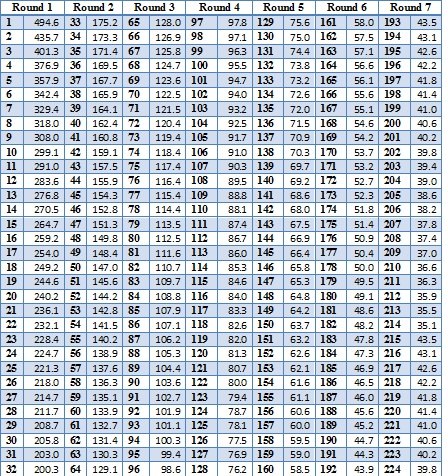
The NFL Draft features numerous trades, many of which seem to conform to the classic draft value chart. It's almost dogmatically accepted, but does it always make sense? My dad once told me to look at the extremes. He was referring to sanity checking if a proposed function made sense or not by testing it at variable=0 or infinity, but the same concept can apply here. Granted I'm backing the following up with little concrete data, but let's take a look at a few examples:

Trading from 2nd to 1st costs about a 2nd rounder. Getting to the top spot means you can guarantee picking that one blue-chip, can't-miss tackle or quarterback. If there's a dropoff after them, forfeiting a good shot at another starter makes sense. If you didn't, you'd be taking a bigger risk on the 1st rounder not working out. If it only cost an additional 3rd, this would be a clear win for the team trading up. If it cost an additional 1st, it would mean the team misses out on a premium pick. This passes the smell test.

The 20th pick is valued equally to the 33rd and 65th. At 20, there's unlikely to be a premium quarterback, tackle or pass rusher. While there may be an elite tight end, nose tackle or inside linebacker, these are positions of lesser impact. In other words, we're looking at players who either have limited impact no matter what, or have a red flag in either college production, measurables or character. The 33rd pick is a little more of the same, and may actually be more appropriate value-wise for the lesser impact positions. The 65th is skirting the territory where guys with clear NFL upside are disappearing, so finding a good role player is often the best outcome. This, again, feels like a reasonably fair trade. Another way to look at it is: the team with the top pick got their blue-chipper, and now they want to go all in for a particular player they want to take a chance on instead of waiting for the board to play out. Never underestimate the perceived value of getting to pick the particular player you want instead of taking who is left for you.

In general, the classic chart lets a team move up about half a round by trading their pick in the next round (ex: mid-2nd + 3rd = borderline 1st), and about a quarter round by throwing in their pick from 2 rounds later (ex: mid-2nd + 4th = higher pick by about 8 spots in the 2nd). What this expresses is that getting to pick the particular player they feel good about is worth not getting to take a chance on a lesser prospect later.

A very important thing to remember here is that the values assigned to each pick are generalized guidelines. Making a big trade up in some drafts has little to no reward. For example, 2013 and 2012 featured similarly graded blue-chip players at the same premium position. The Redskins had no reason to trade beyond the 2nd pick because both Luck and RG3 were franchise-changing quarterbacks (pending discovery of the indestructible ACL ... ). This year, the Jags had no reason to trade up to take the tackle of their choice because both Fisher and Joeckel are dominant, can't-miss players. In other words, the 1st and 2nd pick were worth about the same. Suppose RG3 wasn't there last year. Now suddenly, the benefit of trading to 1 is huge because no other quarterback in the draft compares to Luck. 2013 featured a glut of similarly graded players at a variety of positions. The Raiders traded their 3rd pick to the Dolphins for the 12th and 42nd. Per this chart, they gave the Dolphins a 50% discount. Why? Because they were desperate to add extra picks, and the quality of player they were likely to draft at 12 was not much lower than what they would have goten at 3. Getting 2 shots at the premium part of the prospect list was worth passing on Milliner or whoever they would have taken in their original spot. As such, we can't say that any trade value chart is inherently correct, there's too much contextual information missing without actual players plugged in.

We can, however, call out clearly degenerate cases. In the latter rounds, the gaps in relative values of picks get oddly large. Per the chart, the 211th pick is worth as much as 222, 223 and 224 combined. We're really looking at the scraps at this point, and picks are really a crapshoot here. We're essentially talking low-yield lottery tickets (keep in mind most 7th round picks won't even make the final roster). So why should 1 of these (at 211) be worth as much as 3 of these just a few spots later? This makes no sense at all. Similarly, the last 3 picks of the 6th round are worth as much as the last pick in the 4th. In the 4th, we're still looking at guys who have good physical skillsets and are expected to make the team and contribute. 6th rounders usually have significant physical shortcomings that most never make it past.

The classic chart uses an approximately exponentially decreasing point value model (about a factor of 2 per round) until the top of the 5th, when it changes over to an almost exactly linearly decreasing model. I guess it's trying to account for teams targeting specific crapshoot players, which again has perceived value to the team ... but really, would you elect to have more randomly given scratchers tickets, or hand-pick fewer of them?

Overall grade: B+. The top 4 rounds seems pretty reasonable, but the scale erodes in the later rounds.

To attempt to address the perceived arbitrariness of the classic model, a group created the Harvard model. Right off the bat we can tell that the later rounds are addressed: there's very little difference between 6th and 7th rounders, in fact it's not even possible (per the chart) to engineer a trade back in the 6th without the buyer grossly overspending (or getting into some crazy exotic pick swapping). Unfortunately the Harvard model completely faceplants in the earlier (aka: "important") rounds. For a 7th rounder, a team can move from the 32nd to the 20th, or from 16th to 10th, or from 10th to the 6th pick, or from 5th to 3rd, or 3rd to 2nd. This is lunacy. That 7th rounder is worthless, and you're telling me I can instead have my choice of blue-chip prospect, maybe align that with a need, or hop forward spot(s) to get the clearly better of 2 options? No no no no no. In the Harvard model, the 1st can be had from 7th with the addition of a 2nd rounder, or from the 3rd with the addition of a 4th rounder, or from 2nd with the addition of a 6th. Again, not a chance the seller would go for it. There's also a very oddly large discontinuity form the 32nd to the 33rd pick that should make any basic sanity checker scratch their head. And just to pile it on, the last few picks in the 7th are actually more valuable than those in the middle of the 7th (though this may be a copy/paste error, the sequence from 193 repeats starting at 215).

Overall grade: F. I appreciate their attempt at a statistical approach, but sometimes we don't use the right stats or put them together the right way and a simple smell test should say "no, this doesn't make sense". Anyone who reads KC Joyner's articles should be familiar with this reaction. The meat of the draft is in the top 2 rounds and getting values clearly wrong here makes the scale unusable.

Contributors

Followers